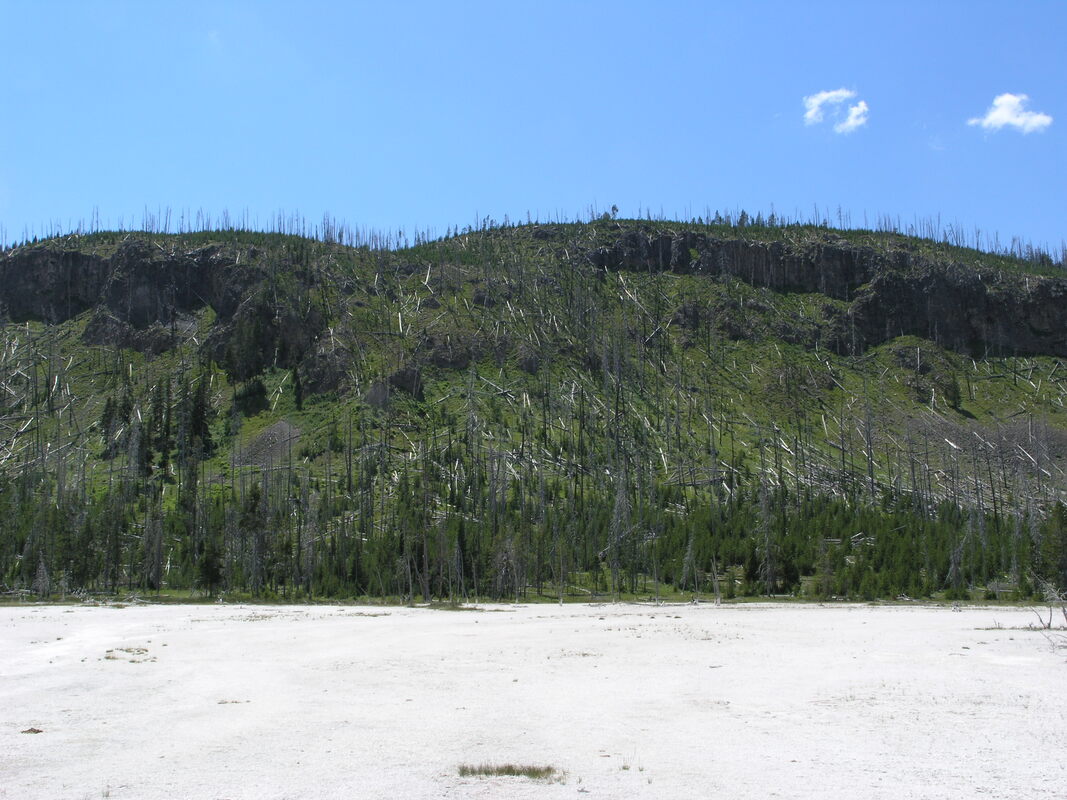
Photos: TOP: A failed tree-planting project in northern China. Copyright 2007 Delena Norris-Tull
BOTTOM: Natural re-growth of trees after a wildfire, Yellowstone National Park. Copyright 2006 Delena Norris-Tull
Commentary by Dr. Delena Norris-Tull, Professor Emerita of Science Education, University of Montana Western, March 2022.
Tree Planting: Pros and Cons
The article below provides a detailed assessment of the benefits and problems with planting trees for the purposes of enhancing carbon sequestration. As with everything else, it is a complicated solution that does not always attain the hoped-for results.
Article by Catrin Einhorn. (March 14, 2022). Tree planting is booming. Here’s how that could help, or harm, the planet. The New York Times.
The World Economic Forum developed a report, Transforming Food Systems with Farmers, to assist the European Union nations in developing sustainable agricultural practices, practices the WEF calls Climate-Smart Agriculture. Page 36 of the report describes tree intercropping as, "Agroforestry systems that grow trees together with annual crops in a given area at the same time." Tree intercropping could reduce annual carbon dioxide emissions by 1.7 million tonnes/ha/year.
The report states that, “if just an additional 20% of farmers adopted climate-smart agriculture, by 2030, the EU could reduce its annual agricultural GHG (Greenhouse Gas) emissions by 6% and improve soil health over an area equivalent to 14% of EU’s agricultural land while improving farmer livelihoods by between €1.9 and €9.3 billion annually” (WEF, 2022, page 4). The WEF recommends 28 climate-smart agricultural practices, which are listed on page 7 of the report. A number of those practices are also elaborated on in within this website.
Reference:
World Economic Forum. (April 2022). Transforming Food Systems with Farmers: A Pathway for the EU. World Economic Forum, in collaboration with Deloitte & NTT Data.
Return to Agricultural Best Practices:
Links to more Innovative Solutions:
BOTTOM: Natural re-growth of trees after a wildfire, Yellowstone National Park. Copyright 2006 Delena Norris-Tull
Commentary by Dr. Delena Norris-Tull, Professor Emerita of Science Education, University of Montana Western, March 2022.
Tree Planting: Pros and Cons
The article below provides a detailed assessment of the benefits and problems with planting trees for the purposes of enhancing carbon sequestration. As with everything else, it is a complicated solution that does not always attain the hoped-for results.
Article by Catrin Einhorn. (March 14, 2022). Tree planting is booming. Here’s how that could help, or harm, the planet. The New York Times.
The World Economic Forum developed a report, Transforming Food Systems with Farmers, to assist the European Union nations in developing sustainable agricultural practices, practices the WEF calls Climate-Smart Agriculture. Page 36 of the report describes tree intercropping as, "Agroforestry systems that grow trees together with annual crops in a given area at the same time." Tree intercropping could reduce annual carbon dioxide emissions by 1.7 million tonnes/ha/year.
The report states that, “if just an additional 20% of farmers adopted climate-smart agriculture, by 2030, the EU could reduce its annual agricultural GHG (Greenhouse Gas) emissions by 6% and improve soil health over an area equivalent to 14% of EU’s agricultural land while improving farmer livelihoods by between €1.9 and €9.3 billion annually” (WEF, 2022, page 4). The WEF recommends 28 climate-smart agricultural practices, which are listed on page 7 of the report. A number of those practices are also elaborated on in within this website.
Reference:
World Economic Forum. (April 2022). Transforming Food Systems with Farmers: A Pathway for the EU. World Economic Forum, in collaboration with Deloitte & NTT Data.
Return to Agricultural Best Practices:
- Ecologically based Successional Management
- Perennial Crops, Intercropping, beneficial insects
- Soil Solarization
- Natural Farming
- Permaculture
- Organic Farming
- Embedding Natural Habitats
- Conservation Tillage
- Crop Rotation
- Water Use Practices
Links to more Innovative Solutions: